
I can approve every material detail yet still slow a service lane when folds, damaged edges, or awkward cartons complicate daily handling.
I choose flat-packed paper floor mats for fast placement and a clean appearance. I choose folded mats only when the storage or shipping benefit outweighs crease recovery and handling concerns. In either case, I approve the final packing format, carton count, and a real vehicle-use sample before ordering.
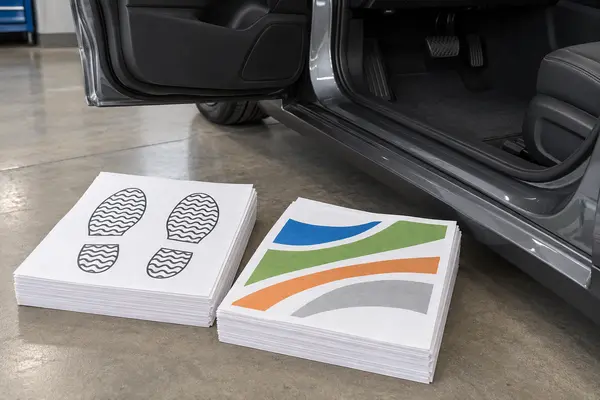
I treat packing format as a working specification, not a small detail added after product approval. The right choice depends on storage, service volume, mat construction, and the buyer's presentation standard.
When Should I Choose Flat-Packed Paper Floor Mats?
I can lose service-lane time when technicians must unfold every mat, even though flat packs require more shelf area.
I prefer flat packing when quick one-hand pickup, a smooth customer-facing appearance, and immediate vehicle placement matter more than minimizing the carton footprint.
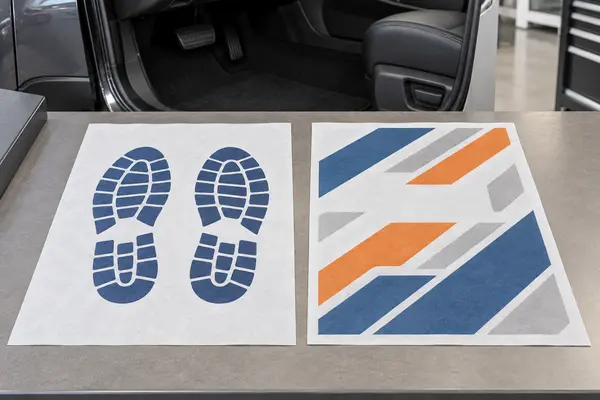
I Match Flat Packing to the Service Workflow
I start at the point of use. I watch where the carton or dispenser will sit, how a technician removes one mat, and how far the mat travels before it reaches the vehicle. A flat stack usually supports a simple motion: pick up one sheet, confirm its orientation, and place it in the footwell. That can help when many vehicles pass through the same lane.
I also consider appearance. A flat mat presents the complete printed face without a central crease. This can matter for vehicle delivery, customer-facing detailing, or branded programs. It also lets me inspect print position, edge damage, and sheet shape quickly during receiving.
Flat packing is not automatically better. A large flat carton needs suitable shelves, floor space, or a dispenser. Poorly supported stacks can curl at the corners, collect dust, or become damaged when other cartons press against them. I therefore approve the storage method with the product.
| Flat-pack factor | What I check | Buyer decision |
|---|---|---|
| Pickup speed | One sheet separates cleanly | Favor flat for high-volume lanes |
| Presentation | Mat lies smooth without preparation | Favor flat for visible customer handover |
| Storage | Shelf and dispenser fit the full dimensions | Confirm space before ordering |
| Carton protection | Corners and faces arrive undamaged | Specify internal support and carton condition |
I use the site's paper floor mat product page to define the product first, then I add the packing format as a separate controlled field.
When Should I Choose Folded Paper Floor Mats?
I may save storage space with a smaller pack, but an unsuitable fold can weaken the sheet, hide the print, or leave the mat uneven.
I consider folded packing when compact storage and handling are important, provided the approved fold opens easily and the mat lies acceptably in the target footwell.
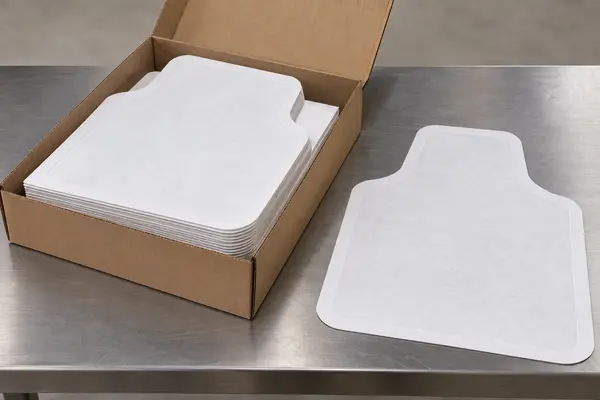
I Approve the Fold, Not Just the Smaller Carton
I ask the supplier to show the exact fold direction, fold position, and number of folds planned for production. I do not approve a loose statement such as “folded packing.” A crosswise fold through an open area can behave differently from a fold through a printed zone, coated layer, or high-contact heel area.
I open several samples from the top, middle, and bottom of a packed group. I note whether one piece can be removed without pulling several mats with it. I then open each mat with the motion a technician would use and place it in a representative vehicle. I check whether the fold remains raised, makes the corners lift, or pushes the mat toward an unsuitable area.
I also inspect the paper surface along the crease. The fold should not produce unacceptable cracking, separation, print damage, or loose particles under the agreed test conditions. If the mat uses a coating or backing, I inspect both sides because the two layers may respond differently.
| Folded-pack question | Acceptable evidence | Warning sign |
|---|---|---|
| Can I open it quickly? | Simple, repeatable unfolding | Extra steps or torn edges |
| Does it lie well? | Stable placement in the chosen footwell | Raised ridge or persistent curl |
| Does the crease remain sound? | No unacceptable visible damage | Cracking, separation, or print loss |
| Is orientation clear? | Print and vehicle direction remain obvious | Fold hides key artwork or direction |
I keep this decision separate from paper strength. My paper-weight selection guide covers the material question; this check decides how that approved construction should be packed.
How Should I Compare Flat and Folded Samples Fairly?
I get a false comparison when paper, coating, dimensions, print, or carton pressure changes with the packing format, so I isolate the packing variable.
I request matched samples made from the same approved mat construction, then compare removal, opening, placement, appearance, crease condition, stacking, and storage under the same workflow.
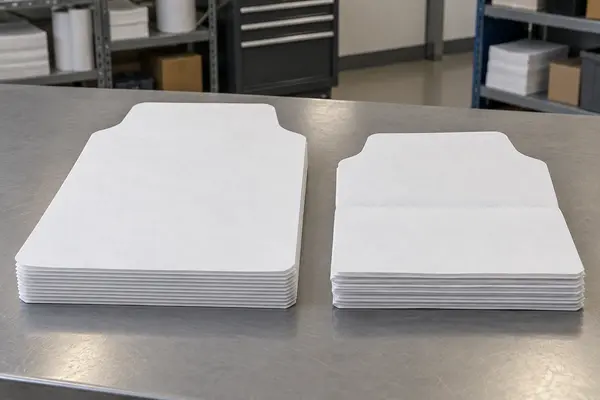
I Run One Repeatable Packing Trial
I label one sample group “flat” and the other “folded.” Both groups should use the same finished size, paper construction, coating or backing, print version, and orientation. I record the packing date or sample reference when available. This prevents a stronger sheet or a different finish from making one format look better for the wrong reason.
I time the workflow only if the buyer finds that useful, but I do not invent a universal speed target. I use the buyer's own service process and define an internal acceptance level. I observe one-piece separation, hand position, unfolding steps, correct orientation, placement, and removal after the planned service period.
Next, I leave representative samples under the agreed packing pressure and storage conditions. I inspect corner curl, fold memory, surface marking, blocking between sheets, and any transfer from print. I also check whether the stack stays orderly after repeated withdrawals. A format that performs well for the first sheet but poorly near the bottom of the pack needs more work.
| Trial stage | Flat sample | Folded sample |
|---|---|---|
| Withdrawal | Check single-sheet pickup and edge damage | Check separation and fold alignment |
| Preparation | Confirm immediate placement | Count opening steps and inspect crease |
| In-vehicle fit | Check curl and movement | Check ridge, curl, and movement |
| Storage simulation | Inspect stack support and dust exposure | Inspect compression and crease memory |
| Final appearance | Review full face and print | Review fold line and print continuity |
I photograph and retain the approved result. The record gives purchasing, production, and receiving teams one clear reference instead of relying on memory.
What Should I Put in My Purchase Order and Receiving Check?
I can receive a different result from the approved sample when my order omits fold direction, pack count, carton support, labels, or change control.
I state flat or folded packing in the purchase order, identify the approved sample, define pack and carton counts, and repeat the same visual and handling checks at receiving.
I Turn the Choice into a Controlled Specification
I begin with the exact product name: disposable automotive paper floor mat. I then record finished size, paper construction, coating or backing when used, artwork revision, print orientation, and packing format. For folded mats, I add fold direction, fold position, and the approved opening method. For flat mats, I add the required stack support and protection against bent corners or crushed edges.
I state pieces per inner pack, inner packs per carton, total pieces per carton, carton dimensions, gross weight, item code, and carton marks. I also identify the agreed quantity-counting method and any buyer-approved quantity tolerance. These fields help me compare freight, storage, and replenishment without turning an estimated carton count into a product claim.
At receiving, I sample more than the top of one carton. I verify identity and counts, then inspect mats from different positions for creases, curl, blocked sheets, print transfer, dirt, moisture damage, and edge deformation. I repeat the one-piece removal and vehicle-placement check. If production changes the paper, coating, dimensions, artwork, folding pattern, or pack method, I require a new review rather than assuming the old approval still applies.
My manufacturing position is practical: I use a raw-material selection process and do not use recycled production waste as substitute material. I focus on stable quality, fair value, order quantity accuracy, and export-risk reduction. These priorities support the written specification, but they do not replace sample approval and receiving inspection.
I choose flat or folded paper floor mats by testing the real service workflow, then lock the approved packing method, counts, carton details, and receiving checks into the order.