
A disposable paint mixing cup can have clear graduations and still rock on the bench, interrupting mixing and increasing spill risk.
I inspect flat-bottom stability by checking the base, measuring rocking, filling the cup to a defined working level, and repeating the test across sizes and cartons before approval.
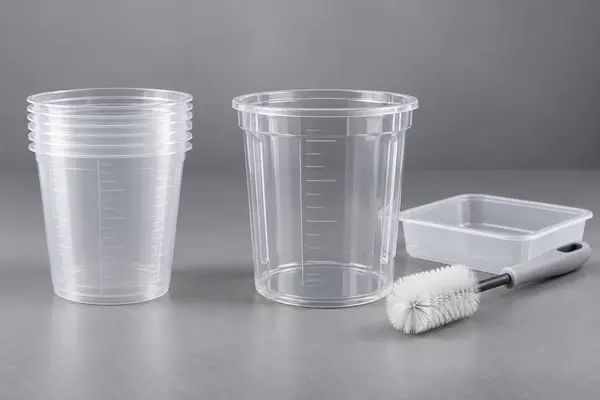
I treat the base as a functional part of the cup, not a cosmetic detail. My check answers one purchasing question: will the cup remain stable while a technician adds components, stirs, reads the scale, and prepares the next step?
Why should I inspect the bottom of disposable paint mixing cups?
A small base defect can make a cup wobble, tilt, or move when the technician stirs. Repeated movement slows work and can contaminate the bench.
I inspect the bottom because a flat, stable cup supports consistent handling. I compare the approved sample with production samples and separate base flatness from wall strength, lid fit, and printed-scale accuracy.
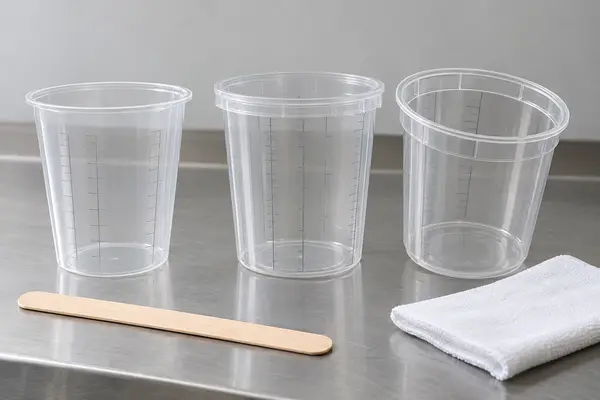
I identify the support surface first
I look at the outside bottom and identify whether the cup rests on a continuous flat area, a supporting ring, feet, or another molded structure. I do not assume that a recessed bottom is defective. I ask whether the design is intended to keep the liquid area level while the support ring contacts the bench.
| Base area | What I inspect | Purchasing risk |
|---|---|---|
| Outer support | Continuous contact, feet, or ring | Uneven contact can create rocking |
| Bottom plane | Flatness and visible distortion | A curved plane can tilt the liquid surface |
| Base edge | Flash, dents, or sharp uneven sections | Local defects can lift one side |
| Wall-to-base transition | Cracks, thin spots, or sink marks | Stress can spread during stirring |
| Marking position | Scale remains readable when upright | A tilted cup can change reading comfort |
I keep the approved sample as my reference
I label one reference cup with its capacity, material description, artwork revision, and supplier code. I photograph the bottom and side profile. If the supplier changes the mold, resin, wall construction, base shape, or packing method, I request a new approval sample.
I inspect empty cups before using liquid
I place the empty cup on a clean, level surface. I check for rocking, visible gaps, crushed edges, and a cup opening that leans noticeably. I do not use a damaged cup to define the normal condition.
How do I run a repeatable flat-bottom stability test?
A quick touch can make a cup seem stable even when it rocks under a mixing load. I need a simple sequence that buyers and suppliers can repeat.
I use a level bench, an empty-cup check, a defined working fill, and a controlled stirring movement. I record the base condition before and after the test.
I fix the test conditions
I choose the same bench surface, cup size, fill level, stir tool, and test sequence for every comparison. I do not compare a small cup filled lightly with a large cup filled near its working level without recording the difference.
| Test condition | My fixed method | Why I control it |
|---|---|---|
| Surface | Clean, hard, level bench | Prevents a dirty surface from causing tilt |
| Fill level | Defined working volume below the rim | Weight changes base loading |
| Stirring | Same tool and circular movement | Side force can reveal instability |
| Observation | Side profile and base contact | Captures rocking and lean |
| Repeat count | Multiple cups from selected cartons | Shows process variation |
I check rocking before and after filling
I press lightly at several points around the empty cup and note whether it tips, clicks, or returns to the same position. I then add a safe, agreed test liquid to the working level and repeat the check. I do not use an unknown coating merely to create a dramatic result.
I observe the liquid surface and the cup wall while the cup is still. If the cup leans, the liquid level may appear different from one viewing angle. I record this as a handling concern rather than claiming that the graduations themselves are inaccurate.
I add a controlled stirring movement
I stir at a normal, repeatable speed and keep the tool away from the rim. I watch whether the cup slides, rotates, rocks, or lifts at one edge. I also check whether the base remains stable when the tool touches the bottom. A flat bottom should support the process, but I do not claim that any cup is spill-proof.
I repeat the check across the carton
I select cups from the top, middle, and lower sections of sample stacks. I note carton code, stack position, cup size, and base result. One stable cup does not represent a shipment.
Which base defects should make me hold a bulk order?
Not every cosmetic mark changes use, but repeated rocking or permanent lean can disrupt mixing. I need a consistent decision rule before receiving production goods.
I hold approval when the same instability appears across samples, when the cup cannot stand without support, or when the base changes shape during normal handling. I investigate isolated damage separately.
I classify the observation before assigning a cause
| Finding | My interpretation | My next action |
|---|---|---|
| Cup stays stable empty and filled | Base performs in the basic check | Continue scale, rim, and material checks |
| One cup rocks after carton removal | Possible packing or local damage | Isolate and repeat with a clean sample |
| Several cups rock at the same location | Repeated base or mold issue | Hold approval and request correction |
| Cup leans after filling | Base or wall geometry may be distorted | Compare with approved reference |
| Base shifts during stirring | Handling stability is insufficient | Review construction and working method |
| Cracks appear at the transition | Structural defect requires review | Isolate affected lot and expand inspection |
I connect stability to the complete work step
I place a stable cup beside the mixing station and follow the real sequence: read the ratio, add components, stir, pause, and move the cup. I check whether the cup remains upright when a lid is placed or when a technician moves the stick from one side to the other.
I keep this inspection separate from stack separation. A cup can release easily from a nested stack and still rock on the bench. I also keep it separate from pouring control because a stable base does not prove that the rim pours cleanly.
I review different sizes separately
I do not transfer the result from a 350 ml cup to a 2,300 ml cup without testing. The taper, wall height, base diameter, and working load can change by size. If the supplier uses one artwork family across several capacities, I still approve each physical base construction.
What should I include in the purchase order and receiving plan?
“Flat-bottom cup” is not enough if the supplier can change the base ring, mold, packing pressure, or material without notice.
I link the approved cup, base design, working fill, and stability test to the purchase order. I record sampling points so receiving staff can repeat the same decision after delivery.
I write a specification that staff can verify
| Purchase field | What I record |
|---|---|
| Product identity | Capacity, material, rim, base, and artwork revision |
| Base construction | Flat plane, support ring, feet, or approved profile |
| Stability method | Surface, fill level, stirring movement, and observations |
| Condition | No rocking, permanent lean, cracks, or severe base distortion |
| Sampling | Cartons, stack positions, sizes, and sample quantity |
| Change control | New approval for mold, resin, wall, base, packing, or artwork changes |
I sample cartons from different positions
I inspect cartons from different pallet positions when the order allows. I open selected stacks and check cups from the top, middle, and lower sections. I record whether a defect is isolated or repeated. I separate damaged cups from true construction failures so the supplier receives a useful report.
I connect base stability to storage and transport
Carton compression, temperature changes, and long storage can affect a thin plastic cup. I review the inner-pack arrangement, carton support, stacking direction, and protection around the rim and base. I do not invent a storage-life guarantee; I specify the conditions that matter and ask the supplier to confirm the packing design.
I protect repeat orders from silent changes
I require reapproval when the supplier changes raw material, mold, wall thickness, base profile, stack support, printed surface, lid code, or carton load. I use a raw-material selection process and do not use recycled production waste as substitute material. I focus on stable quality, fair value, order quantity accuracy, export-risk reduction, experienced production staff, and flexible production lines for large orders, while keeping these priorities tied to documented samples.
I approve a disposable paint mixing cup only when the base stays stable empty and filled, remains steady during controlled stirring, and matches the written inspection plan. A simple flat-bottom check can protect an entire paint-room workflow.